Spring Is Prime Ray Season — Here's Exactly When and Where to Find Them
If you've ever booked a snorkeling trip specifically hoping to encounter rays and come home with nothing but a sunburn and a blurry GoPro clip of a parrotfish, there's a decent chance you went at the wrong time of year. Not the wrong destination — the wrong season.
Rays, like most marine wildlife, follow rhythms that have nothing to do with peak travel season, spring break calendars, or when airfare happens to be cheap. Understanding those rhythms is the difference between a trip where you spot a dozen southern stingrays gliding across a sandy flat and one where you spend an hour staring at empty water.
Spoiler: spring is often the sweet spot. But it's more nuanced than that.
Why Spring Matters for Ray Activity
Across multiple ray species found in US coastal waters and popular Caribbean snorkeling destinations, spring marks a convergence of factors that push rays into shallower, more accessible waters.
Water temperatures are rising but haven't yet hit the extremes of summer. Prey species — small fish, crustaceans, mollusks — are becoming more active in nearshore environments. And critically, many ray species begin their breeding migrations during late winter and spring, moving through predictable corridors in large numbers.
For snorkelers, this creates a window of opportunity that's genuinely hard to replicate at other times of year.
Southern Stingrays: The Caribbean Calendar
The southern stingray (Hypanus americanus) is probably the species most snorkelers encounter in the Caribbean — it's the iconic flat, diamond-shaped ray that glides across sandy lagoon floors in places like the Cayman Islands, Turks and Caicos, and the US Virgin Islands.
Through late winter and into spring, water temperatures in these destinations hover in the low-to-mid 70s Fahrenheit — ideal for southern stingrays, which are most active in the 72°F to 82°F range. As temperatures climb into the upper 80s during peak summer, these rays often shift into deeper, cooler water where recreational snorkelers simply can't follow them.
The sweet spot for the Caribbean? March through May. You'll find rays in shallower sandy areas, feeding more actively during daylight hours, and moving through lagoon systems in higher concentrations than during the summer months.
After June, encounters become more hit-or-miss in the shallows. The rays are still there — they're just harder to reach.
Cownose Rays: The Atlantic Migration You Need to Know About
If the Caribbean stingray is the superstar, the cownose ray (Rhinoptera bonasus) is the spectacle. And spring is entirely their moment.
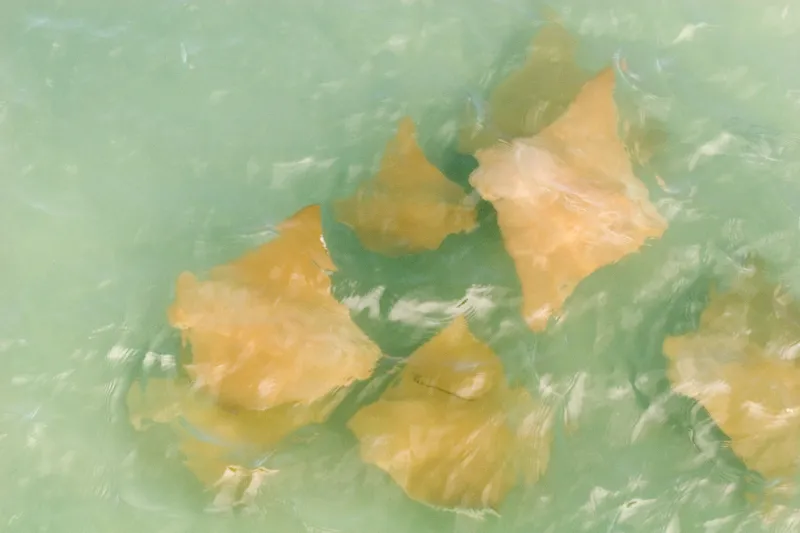
Cownose rays migrate along the US Atlantic coast in massive schools — sometimes numbering in the thousands — moving northward in spring and reversing south in fall. This migration follows water temperature, with the northward push typically beginning off the Florida coast in late March and April, progressing through the Carolinas and into Chesapeake Bay waters through May and June.
For snorkelers willing to be in the right place at the right time, encountering a school of cownose rays is one of the most dramatic wildlife experiences available in US coastal waters. These aren't shy animals — schools often move through relatively shallow water, and patient snorkelers positioned along known migration corridors can find themselves surrounded by hundreds of rays moving in formation.
The challenge is timing. The migration window at any given location can be as short as a few weeks. Local charter operators and marine biology stations along the coast typically track these movements, and checking in with them before booking is well worth the effort.
Spotted Eagle Rays: Florida's Spring Visitors
The spotted eagle ray (Aetobatus narinari) is arguably the most visually striking ray species accessible to snorkelers in US waters — those white spots on a dark back are unmistakable. And while they're present in South Florida and the Keys year-round in small numbers, spring brings increased sightings in specific locations.
Water clarity in the Florida Keys tends to improve in spring after winter weather systems pass, making eagle ray encounters more visually rewarding even when the animals are present in similar numbers. More importantly, spotted eagle rays in Florida are known to aggregate in certain reef zones during spring months, likely related to feeding on the seasonal abundance of mollusks.
April and May are consistently cited by Keys-based snorkel operators as the best months for eagle ray encounters. Summer brings more boat traffic, more snorkelers, and warming water that pushes eagle rays deeper along reef walls where visibility for surface snorkelers diminishes.
When They Vanish — And Why You Should Respect That
Here's the less exciting but genuinely important part of the story: breeding season for many ray species overlaps with the spring window, and that comes with responsibilities for snorkelers.
Cownose rays, for example, give birth in late spring and early summer. Pregnant females and recently born pups are more vulnerable to stress from close human contact during this period. Crowding a school of cownose rays during pupping season — even without physical contact — can cause the kind of repeated disturbance that affects feeding behavior and maternal bonding.
Southern stingrays similarly engage in courtship behaviors in spring that can be disrupted by aggressive approaches from swimmers. If you see rays swimming in tight pairs or exhibiting unusual lateral movements, you're likely watching courtship. Give them space. A lot of it.
The goal of understanding seasonal patterns isn't just to maximize your own encounter — it's to engage with these animals at the times and in the ways that cause the least disruption to their natural cycles. Snorkeling responsibly during breeding season means observing from a respectful distance and never, under any circumstances, attempting to touch or intercept animals that are actively engaged in reproductive behavior.
Planning Your Trip Around the Calendar
Here's a quick reference for US-accessible destinations and their spring ray windows:
- Florida Keys: April–May for spotted eagle rays and increased southern stingray activity in the shallows
- US Virgin Islands / Puerto Rico: March–May for southern stingrays before summer heat pushes them deeper
- Atlantic Coast (NC to Chesapeake): April–June for cownose ray migration schools
- Gulf Coast (Florida Panhandle, Texas coast): March–May for cownose rays and occasional Atlantic stingrays in nearshore waters
None of these windows are guaranteed — marine wildlife doesn't run on a fixed schedule. But these are the periods when the probability of meaningful encounters is genuinely higher, and when the conditions (water clarity, temperature, ray activity levels) tend to align most favorably.
The Bigger Picture
Planning a snorkel trip around wildlife cycles rather than vacation calendars requires a small shift in mindset — but it pays off in a big way. The most memorable ray encounters happen not because someone got lucky, but because they understood when and where these animals naturally concentrate, and showed up prepared.
Spring is your window. Use it wisely.