Your Underwater Camera Might Be Hurting the Rays You Came to See
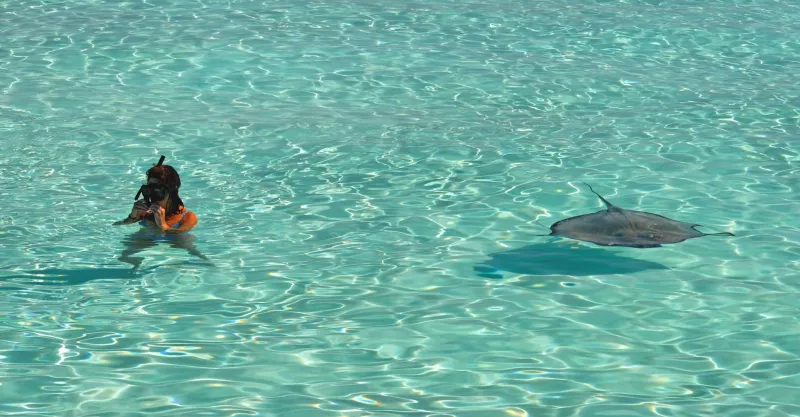
Let's be honest: the underwater camera is now as standard a piece of snorkel gear as fins. GoPros clipped to masks, waterproof phone cases, dedicated underwater housings — the quest for that perfect ray shot is practically baked into the modern snorkeling experience. And the results are genuinely beautiful. Social media feeds are full of stunning close-up footage of southern stingrays, graceful eagle rays, and massive schools of cownose rays gliding through turquoise water.
But there's an uncomfortable question starting to emerge in marine biology circles, and it's one the snorkeling community needs to take seriously: what is all that photography actually doing to the animals?
The answer, according to emerging research, is more complicated — and more concerning — than most snorkelers realize.
The Problem With Being Watched
Marine researchers have long understood that human presence affects wildlife behavior. What's newer is the specific examination of how photographic equipment — particularly the behavior it encourages in the person holding it — amplifies that effect.
A snorkeler who's simply floating and observing tends to maintain a relatively passive position. A snorkeler trying to frame a shot does something very different: they approach more closely, they reposition repeatedly, they hover in place for extended periods, and they sometimes make sudden movements to adjust angles. All of these behaviors register as potential threats to rays, which have evolved highly sensitive electroreceptors (called ampullae of Lorenzini) that detect movement and pressure changes in the water around them.
Studies conducted at heavily visited snorkel sites in the Caribbean and Indo-Pacific have documented measurable changes in ray behavior at sites with high photographic activity compared to lower-traffic sites. These include increased flight responses, reduced feeding time in shallow areas, and shifts in habitat use — with rays gradually spending less time in the accessible shallows where photography occurs most frequently.
That last point is particularly significant. If photography pressure is training rays to avoid the shallow sandy flats where they naturally feed, we're not just affecting individual animals — we're potentially altering population-level behavior over time.
The Drone Dimension
Underwater cameras are one part of the equation. Drones are increasingly another.
Aerial drone photography over snorkeling sites has become common, driven by the same desire for compelling content. And while drones don't enter the water, research on cetaceans and marine mammals has shown that drone noise and shadow can cause stress responses in animals at the surface — including rays that surface to breach or feed in very shallow water.
Some popular ray aggregation sites in the US and Caribbean have seen a notable uptick in drone usage over the past few years, and at least a few tour operators have started fielding complaints from guests about drones disrupting surface activity during excursions. It's an issue the industry is only beginning to grapple with.
What Tour Operators Are Actually Doing
The good news is that responsible operators aren't waiting for formal regulations to adapt. Several snorkel tour companies operating in high-traffic destinations have begun implementing photography guidelines as part of their standard guest briefings — and some of those guidelines are surprisingly specific.
Common emerging practices include:
- Minimum approach distances for photography. Rather than a general "don't touch" rule, some operators now specify distance limits for camera use — typically six feet or more as a minimum working distance from rays.
- No flash, ever. Underwater strobes and flash units cause startle responses in rays and other marine life. Most responsible operators have banned them outright on their tours.
- Passive photography posture. Guests are coached to keep their body position flat and low in the water when photographing, avoiding the looming overhead approach that triggers the strongest avoidance responses in bottom-dwelling rays.
- Time limits near aggregations. At known ray gathering spots, some operators rotate guests through in smaller groups with enforced time limits, reducing the cumulative pressure on animals in a single location.
These aren't yet industry-wide standards, but they represent the direction things are moving — and snorkelers can apply them regardless of whether their tour operator requires it.
The Ethics of the Perfect Shot
There's a broader ethical conversation worth having here, and it's one that applies to wildlife photography in any context: what are you willing to do to an animal to get your image?
The honest answer for most snorkelers is "not much" — they're not intentionally causing harm, and they'd be genuinely upset to learn their photography session stressed out the ray they were trying to celebrate. But good intentions don't automatically translate into low-impact behavior, especially when the camera is up and the shot looks close to perfect.
A few questions worth asking yourself before you start filming:
Did the animal approach you, or did you approach it? Rays that swim toward snorkelers voluntarily are displaying natural curiosity and are far less likely to be stressed by the interaction. Rays that are being followed are a different story.
How many other cameras are already on this animal? At popular snorkel sites, a single ray can be the subject of a dozen simultaneous photography sessions. The cumulative effect of that attention is significantly higher than any individual photographer's impact.
Would your shot require the animal to change its behavior? If you're thinking about repositioning to cut off a ray's path so you can get a head-on shot, that's a good moment to reconsider.
What the Science Still Doesn't Know
It's worth being honest about the limits of current research. Studies specifically examining camera-related disturbance in ray species are still relatively limited in scope, and the long-term population-level consequences aren't yet fully understood. Some researchers argue that habituated rays at frequently visited sites show fewer stress responses over time — essentially adapting to human presence.
But habituation is a double-edged outcome. Animals that lose their wariness of humans can become more vulnerable to accidental harm from boat traffic, fishing gear, and physical contact. Habituation isn't the same as health.
The precautionary principle applies here: given that we don't fully understand the cumulative effects of millions of underwater photography sessions on ray populations, erring on the side of less intrusive behavior costs us very little while potentially mattering a great deal.
How to Photograph Rays Without Being the Problem
None of this means put the camera away. It means use it thoughtfully. Here's a practical framework:
- Let the animal set the distance. Your best shots will come from rays that are comfortable with your presence, not ones you've chased down.
- Shoot wide before you shoot close. Get your establishing shots from a respectful distance before trying for detail shots.
- Limit your time at any single animal. A few minutes of passive observation and photography is reasonable. Ten minutes of persistent close-range filming is not.
- Skip the drone over active snorkel sites. If rays are visibly present and active, aerial drone footage can wait for another day.
- Share your footage responsibly. If you document unusual or concerning behavior — including distress responses from other photographers — consider reporting it to local marine conservation organizations.
The Future of Ray Tourism
The snorkeling industry has a genuine stake in getting this right. The destinations that draw tourists — the ray aggregation sites, the sandy lagoons, the clear-water flats — are valuable precisely because they support healthy, naturally behaving wildlife populations. Photography pressure that degrades those populations doesn't just harm the animals; it ultimately undermines the experience that makes these places worth visiting.
The operators, researchers, and snorkelers who are taking this seriously aren't trying to restrict the joy of underwater photography. They're trying to make sure that joy is still available twenty years from now.
The ray in your viewfinder is not a prop. Treat it accordingly.