What Stingrays Are Actually Telling You: A Snorkeler's Guide to Reading Ray Behavior
Let's be honest — the word "stingray" still makes a lot of people nervous. Maybe it's the name. Maybe it's that one Steve Irwin documentary clip that keeps circulating on social media. Whatever the source of the anxiety, the fear is almost always bigger than the actual risk. Stingrays are not aggressive animals. They're not lurking in the shallows waiting to ruin your vacation. In fact, once you understand what they're communicating through their movements and posture, you'll probably want to spend every snorkeling trip hunting for them.
At Snorkel Ray Tours, rays aren't just our namesake — they're the reason so many of our guests come back year after year. We've spent a lot of time in the water alongside these animals, and we can tell you with confidence: knowing how to read their behavior changes everything.
Why Stingrays Behave the Way They Do
Before diving into specific signals, it helps to understand the basic motivations driving stingray behavior. These animals are bottom-feeders, spending most of their time cruising sandy flats, reef edges, and seagrass beds in search of crustaceans, worms, and small fish. They're not territorial in the way sharks can be, and they have no natural reason to seek conflict with something as large as a human.
The barbed tail — the source of so much anxiety — is a last-resort defense mechanism, not a weapon they deploy casually. A stingray uses its tail when it feels genuinely cornered or physically threatened. That's an important distinction. Most stingray injuries happen when someone accidentally steps on a buried ray, not during intentional encounters while snorkeling.
Reading the Signals: What Different Behaviors Mean
Calm, flat posture while swimming: This is your green light. A stingray gliding smoothly along the seafloor or through open water with its wings moving in slow, fluid strokes is a relaxed animal. It may be curious about you, or it may be entirely indifferent. Either way, you're not a threat in its eyes.
Hovering or circling near you: At popular snorkel sites — especially places where tour operators have historically fed rays — some stingrays have learned to associate humans with food. If a ray circles you or nudges gently around your fins, it's likely hoping for a handout rather than sizing you up as a threat. This is actually a sign of comfort, not aggression. That said, feeding wild rays isn't something we recommend for reasons we'll get into shortly.
Arching the back or raising the tail: Pay attention to this one. When a stingray arches its body upward or lifts its tail into a curved position, it's communicating discomfort. This is the equivalent of a dog growling — it's a warning, not an attack. If you see this posture, back off slowly and give the animal more space. Don't make sudden movements, and definitely don't reach toward it.
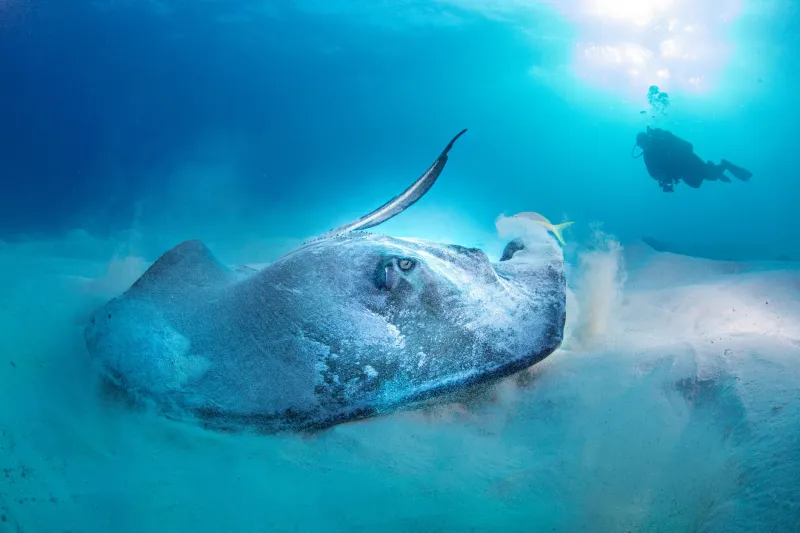
Burying or flattening into the sand: Stingrays are masters of camouflage. If one suddenly flattens itself and starts kicking up sand, it's either trying to hide or feeling stressed. This is a clear signal to give it room. Hovering directly over a buried ray and waiting for it to re-emerge puts stress on the animal and increases the chance of a defensive reaction.
Rapid, erratic swimming: If a ray suddenly bolts — wings flapping quickly and directionally away from you — it's spooked. This usually means you've gotten too close too fast. The good news is that a fleeing ray isn't a threat. Let it go and approach the next encounter more slowly.
The Golden Rules of Ethical Ray Encounters
Understanding body language is only half the equation. The other half is making sure your behavior in the water supports a respectful interaction rather than a stressful one.
Approach from the side, not from above. Coming down on a ray from directly overhead mimics the attack pattern of a predator. Instead, descend to its level and approach at an angle. Move slowly and steadily — abrupt motions read as threatening.
Keep your hands to yourself. We know it's tempting. Rays have an incredibly smooth, almost velvety texture, and they can seem almost inviting to touch. But handling any wild marine animal disrupts its natural behavior, can remove protective mucus from its skin, and — in the case of rays — puts you in closer proximity to the tail than you need to be. Watch, don't grab.
Don't chase. If a ray moves away from you, respect that decision. Chasing a stingray is stressful for the animal and usually results in a more erratic encounter anyway. The best sightings come when you stay calm and let the ray set the pace.
Skip the feeding. We mentioned this above, and it's worth expanding on. Feeding wild stingrays creates dependency, alters their natural foraging behavior, and can lead to overcrowding at specific sites. It also habituates rays to close human contact in ways that occasionally lead to injuries — not because the ray is aggressive, but because an animal expecting food and getting none can become pushy and unpredictable.
Shuffle your feet when wading in shallow water. This applies more to beachgoers than snorkelers, but it's worth knowing. Shuffling sends vibrations through the sand that alert buried rays to your presence, giving them time to move before you accidentally step on one.
What to Do If a Ray Gets Uncomfortably Close
First: don't panic. Thrashing and splashing in response to a nearby ray is far more likely to cause a problem than staying calm. If a ray swims directly toward you, hold your position, keep your fins still, and let it pass. Most of the time, it will veer off naturally.
If a ray seems unusually persistent — circling, nudging, or following you — it's almost certainly been fed by humans before and is hoping you have snacks. Slowly swim away toward shallower water or back to your boat. There's no need for alarm, just a gentle exit.
The Bigger Picture: Why These Encounters Matter
Stingrays are genuinely remarkable animals. They navigate using electroreception — sensing the electrical fields of prey buried in sand. Some species travel hundreds of miles in seasonal migrations. Several species are listed as vulnerable or endangered due to habitat loss and bycatch. Every respectful encounter you have with a wild ray is an opportunity to connect with an animal that most people never take the time to understand.
At Snorkel Ray Tours, we believe that education and respect go hand in hand. The more you know about what stingrays are communicating, the better your experience will be — and the safer both you and the animal will come out of it. So next time you spot that diamond shape gliding along the seafloor, take a breath, slow down, and watch. You might be surprised by what you see.